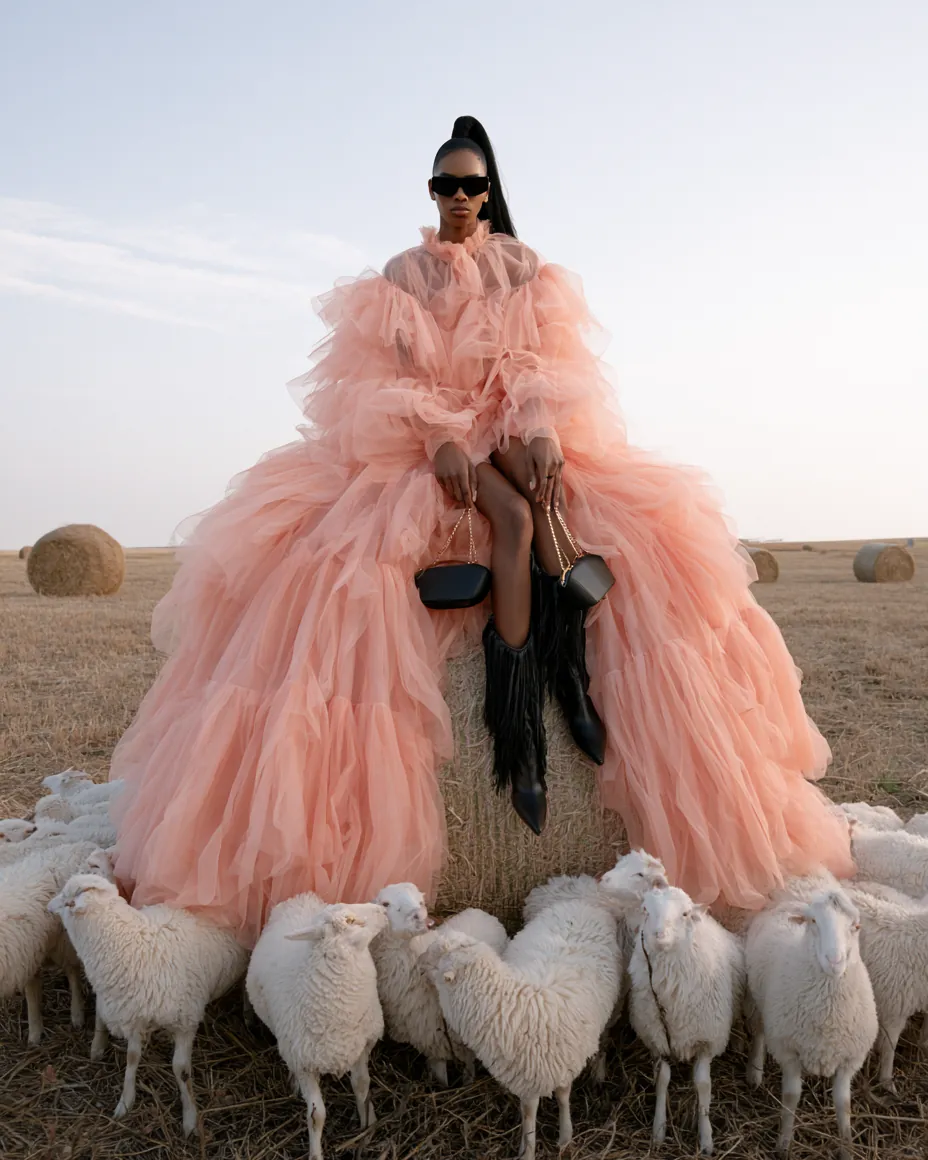
Start with the point of view
Before camera terms, materials and lighting, there should be a reason for the frame to exist. What is the tension? What is unexpected? What should the viewer understand in one second? That is the idea.
A prompt is useful later because it translates decisions into production instructions. It cannot replace the decisions themselves. More adjectives do not automatically create a stronger concept.
Separate concept from execution
‘A woman in a field wearing a dress’ is a subject. ‘Soft romantic editorial’ is a mood. Neither is yet a complete creative idea.
Direction begins when those ingredients are given a relationship: couture scale against an ordinary cut field, soft translucent fabric against dry stubble, elegance placed somewhere intentionally unglamorous. Now the choices have a reason to exist together.
The prompt tells a tool what to do. The idea tells you why the image deserves to exist in the first place.
Build the production brief in layers
Once the idea is clear, the prompt becomes easier to write because the hierarchy is known. A useful order is: concept and feeling, subject, environment, composition and camera, light, materials, physical behaviour, fidelity constraints and only then technical generation details.
This also makes iteration more intelligent. If the image fails, you can ask whether the concept is weak, the art direction is unclear, or the execution is simply inaccurate. Without that hierarchy, every problem looks like a prompt problem.
Tools should stay in service of the image
Different models and workflows will interpret the same direction differently. That is normal. The creative standard should survive the tool change.
A good workflow is therefore not a collection of magic phrases. It is the ability to make a decision, test it, diagnose what is wrong and translate the same visual intention into whatever production method is appropriate.