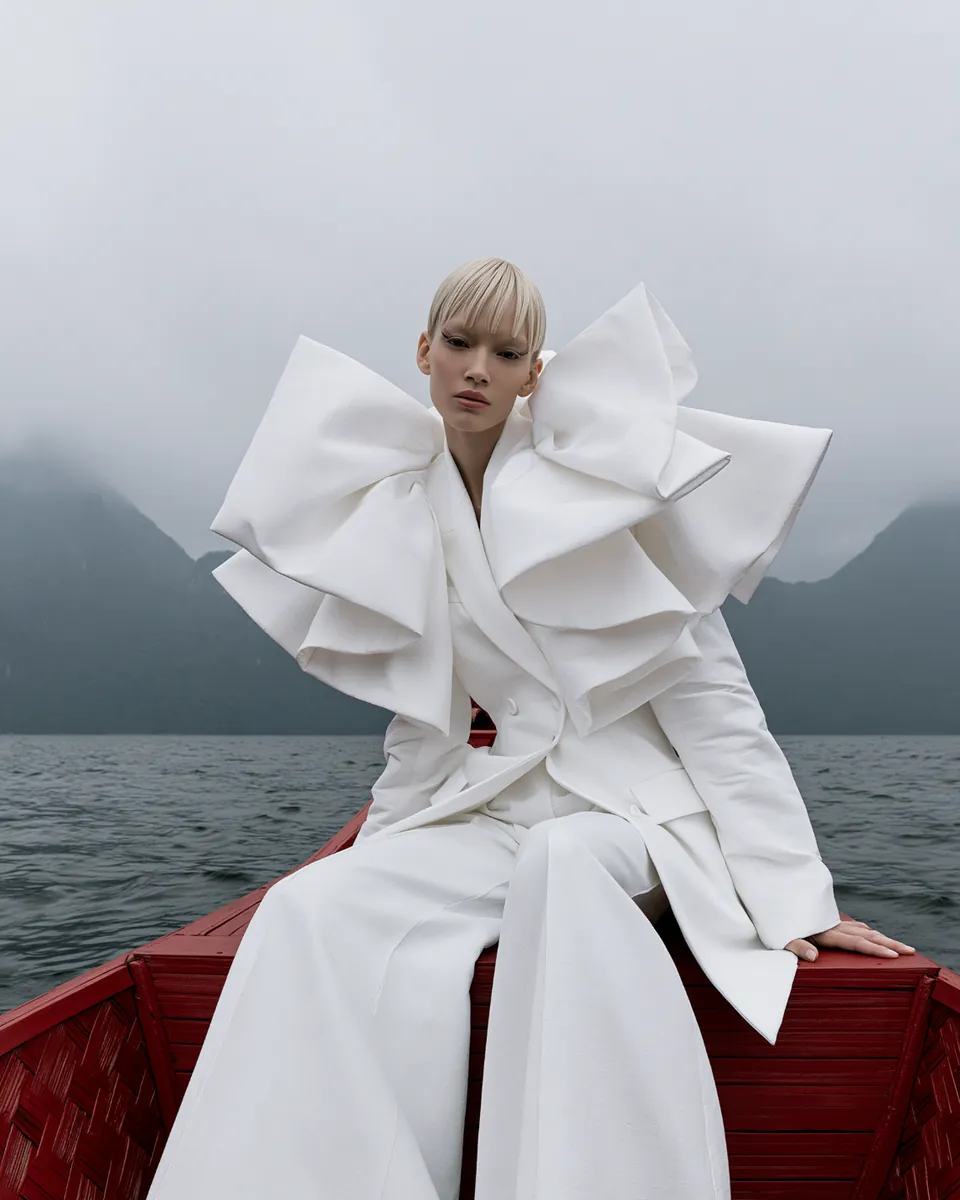
Find the rules, not the objects
If the anchor frame contains a red boat, the answer is not to put a red boat into every following image. That would repeat an object rather than extend a visual language.
Look instead for the deeper rules: the relationship between subject and environment, the level of contrast, the lens behaviour, the distance of the camera, the palette, the material choices and the amount of visual tension in the composition. Those rules can survive when the location or pose changes.
Lock what must stay consistent
Every visual world needs a small set of non-negotiables. It might be the wardrobe silhouette, a product shape, a face, a lighting direction or a colour relationship. Define those anchors before expanding the set.
Everything else can move. Camera height can change. A wide frame can become a close-up. Stillness can become motion. The series feels connected because the important decisions remain stable, not because every shot is a copy of the first one.
The goal is not to make every image look the same. It is to make every image feel like it could only belong to this project.
Design variation deliberately
Consistency without variation becomes a contact sheet. Variation without consistency becomes a moodboard. A useful campaign sits between the two.
Plan a rhythm: establishing frame, medium composition, detail, unexpected angle, movement, quieter reset. In motion, the same principle applies to camera behaviour and pacing. Each shot should add information while still belonging to the same world.
Use the first frame as a test
Before producing a full set, the anchor frame should prove the hardest things: materials, lighting logic, identity or product fidelity, environment and overall taste level. If those elements are not convincing in one image, producing ten more will not solve the underlying problem.
Once the first frame is doing the job, expansion becomes less about chasing luck and more about directing a system.